
Estimated reading time: 9 minutes
Strength training helps your body produce and control force. It uses resistance from free weights, machines, resistance bands, cables, or your own body weight to challenge the muscles. With consistent practice and suitable recovery, the body adapts by becoming stronger, steadier, and better prepared for physical demands.
Many people begin because they want to build muscle or change their appearance. Those goals are valid, but the health benefits reach into nearly every part of daily life. Increased muscle strength can make stairs, groceries, luggage, household work, and recreational activities easier. Resistance training can also support bones, joints, posture, balance, body composition, and confidence.
What are the benefits of strength training? The best results come from a program that fits the person. Your starting point, injury history, mobility, schedule, fitness level, and goals should all influence the exercises you perform. A beginner may need supported body-weight movements and light resistance. An experienced client may need heavier loads, additional sets, or advanced exercise variations.
Body360 Fit takes this individualized approach in its private Beverly Grove studio. Every new client begins with a complimentary Functional Movement Screen before receiving a personalized plan. Sessions are built around movement quality, measurable progress, and efficient coaching without the crowds or distractions of a large gym.
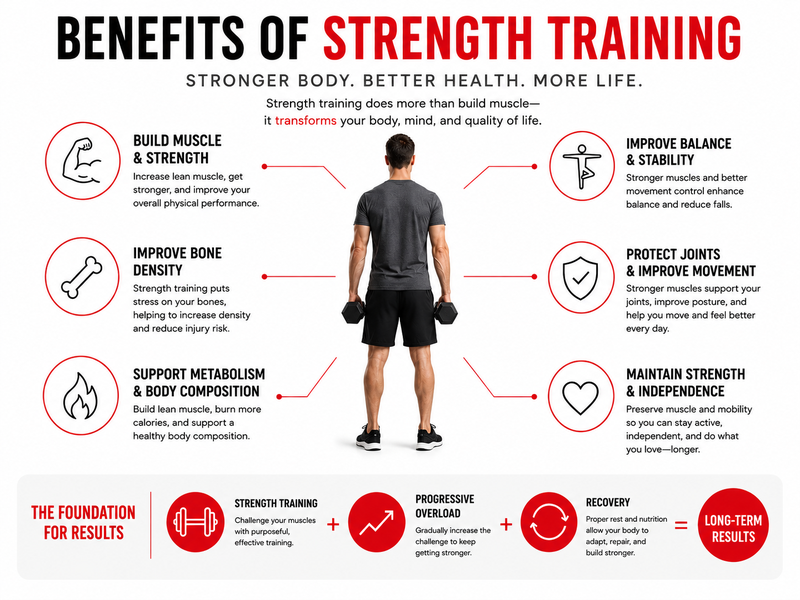
Strength Training Makes You Stronger for Daily Life
The main benefit of strength training is improved physical capacity. Your muscles become better able to create force, control movement, and maintain stable positions. This can make both planned exercise and routine daily activity feel less demanding.
Consider how often strength appears in ordinary tasks. Standing from a low chair requires the legs and hips to produce force. Carrying shopping bags involves grip, arm, shoulder, and core strength. Reaching for an item on a shelf calls for shoulder mobility and trunk control. Even walking up stairs depends on the bodyʼs ability to support and move its own weight.
A structured program develops these abilities through movement patterns that transfer well to daily life:
- Squatting and lunging for sitting, standing, and climbing stairs
- Hinging for lifting objects from the floor
- Pushing and pulling for doors, furniture, and household tasks
- Carrying for groceries, luggage, children, and work equipment
- Bracing and rotating for posture, balance, and controlled movement
Strength exercises also improve muscular fitness, which includes strength, endurance, and the ability to repeat physical work. You may notice that tasks take less effort, that you recover faster, or that you can remain active for longer before becoming tired.
These changes support independence as people age. Maintaining the ability to stand, walk, carry, and recover from a loss of balance can help people continue participating in the activities that matter to them.
Progress doesn’t require lifting the heaviest possible weight. The resistance only needs to challenge the muscles while allowing sound technique. Adding a few pounds, completing another repetition, improving range of motion, or moving with better control can all show that the program is working.
Resistance Exercise Supports Muscles, Bones, and Joints
Resistance training places a controlled demand on the musculoskeletal system. Muscles respond by adapting to the work, while bones and connective tissues are exposed to forces that can support their ability to handle future activity.
Building or maintaining muscle mass becomes increasingly valuable over time. Muscle supports movement, posture, stability, energy use, and recovery from physical stress. Without regular resistance, people may gradually lose strength and lean tissue, particularly during long periods of inactivity or as they grow older.
Strength work also provides a useful stimulus for bones. Exercises that require the body to support weight or control external resistance can support bone health when the program is appropriate for the person. The right plan should consider age, health history, previous fractures, current symptoms, and medical guidance.
Joints benefit from strong, coordinated muscles around them. The muscles of the hips help guide the knees and pelvis. The upper-back and shoulder muscles contribute to arm control. The core helps manage force between the upper and lower body.
Ligament strength and joint stability aren’t created by one isolated exercise. They’re supported through gradual loading, consistent practice, and improved control across a suitable range of motion.
| Training benefit | How the body adapts | Everyday effect |
|---|---|---|
| Greater muscle strength | Muscle fibers and the nervous system become better at producing force | Lifting, carrying, and climbing may feel easier |
| Maintained muscle mass | Regular resistance gives the body a reason to preserve lean tissue | Supports mobility, function, and healthy aging |
| Stronger bones | Weight-bearing resistance places a measured demand on bone tissue | Supports long-term skeletal health |
| Better joint control | Surrounding muscles become stronger and better coordinated | Movement may feel steadier and less strained |
| Improved balance | Legs, hips, core, and nervous system work together more efficiently | May lower the risk of falls during daily activity |
| Better posture | The body gains strength to maintain useful positions | Sitting, standing, and walking may feel more comfortable |
Exercise must still be matched to the individual. Someone with osteoporosis, arthritis, a recent operation, or persistent pain may need medical clearance and modified movements. Training should build tolerance rather than force the body through symptoms.
Strength Training Can Improve Body Composition andWeight Management
Strength work can play a valuable role in fat loss and body-composition goals. It helps build or preserve muscle while nutrition and total activity support a caloriedeficit.
Scale weight alone doesn’t show whether a person is losing fat, gaining muscle, or experiencing changes in hydration. Someone may improve body composition while the number on the scale changes slowly. Clothing fit, measurements, photos, physical performance, and energy levels can provide a fuller view.
Increasing muscle mass also supports how the body uses energy. Muscle tissue requires energy to maintain, although the metabolic effect should be kept in perspective. A few workouts won’t create a dramatic or unlimited rise in calorie use.
The larger benefit comes from the combination of resistance exercise, daily movement, nutrition, sleep, and consistency. A stronger person may also find it easier to complete challenging workouts, walk farther, participate in recreational activity, and remain active throughout the week.
- Strength training can help people work toward lower body fat levels by:
- Preserving lean muscle while body weight decreases
- Increasing the energy used during and after demanding sessions
- Improving physical capacity for other forms of activity
- Creating measurable performance goals that support consistency
- Helping the body look firmer as muscle develops and fat decreases
Aerobic exercise can support heart health, stamina, and calorie expenditure, while resistance work targets muscular strength and lean tissue. The two methods can complement each other. A balanced fitness routine may include strength, aerobicactivity, mobility work, and regular low-intensity movement such as walking.
The best mix depends on the personʼs goal and ability to recover. Adding many workouts at once can create fatigue and make consistency harder. A focused program with two or three resistance sessions per week may be a practical starting point for many beginners.
Better Movement Can Support Pain Management and Protection
Pain is complex, and no single workout can address every cause. Still, carefully programmed strength work may support pain management by improving movement capacity, joint control, posture, and tolerance for physical activity.
Weakness, limited mobility, poor coordination, and repeated compensation can place unnecessary strain on certain areas. For example, limited hip strength may affect how the knees move. Weak upper-back muscles may make it harder to maintain a comfortable position during desk work. Reduced core control may affect how force is transferred during lifting.
Corrective exercise may be used to address these patterns before or alongside heavier training. The goal is not to label every movement difference as a problem. It is to identify limitations that affect comfort, control, or performance and select exercises that help the client move more effectively.
A sensible pain-aware program may include:
- Mobility work for restricted areas
- Stability exercises for joints that need better control
- Gradual resistance to build tolerance
- Modified ranges of motion
- Tempo changes that encourage control
- Balanced work for opposing muscle groups
- Real-time adjustments based on symptoms
Sharp pain, numbness, sudden weakness, dizziness, or symptoms that worsen during a workout shouldn’t be ignored. A qualified healthcare professional should assess unexplained or persistent pain. Personal trainers don’t diagnose medical conditions, but they can adapt exercise within their professional scope and coordinate with healthcare providers when needed.
Body360 Fit uses its Functional Movement Screen to identify limitations, imbalances, and possible injury risks before writing a training plan. Programs may combine mobility, corrective work, strength, fat loss, and conditioning according to the clientʼs needs.
This assessment-led process can help clients avoid random exercise selection. It also gives the trainer a baseline for tracking improvements in movement, stability, and physical confidence.
Training Supports Mental Health, Confidence, and Consistency
The mental health benefits of strength training often develop through the training process itself. Each session creates a clear task, a manageable challenge, and an opportunity to see progress.
Completing a difficult set with good form can build confidence. Learning an unfamiliar movement can improve trust in your body. Recording another repetition or a small weight increase provides visible proof that effort is producing change.
These accomplishments can influence life outside the gym. Clients may feel more capable during travel, work, recreation, or stressful situations. They may also become more willing to attempt activities they previously avoided because they felt weak, unsteady, or self-conscious.
Exercise can provide a structured break from daily stress. During a focused workout, attention shifts toward breathing, movement, posture, and immediate physical feedback. That mental focus may help people feel calmer and clearer after training.
Consistency is easier when the program feels relevant. Generic routines may include exercises that don’t match the personʼs goals or abilities. A personalized plan creates a reason for each movement and a clear path from the current starting point to the desired result.
Coaching also provides accountability. A trainer can monitor technique, adjust the workload, and help a client recognize progress that might otherwise go unnoticed. Body360 Fitʼs private model is designed for clients who want direct feedback, personal attention, and a structured program based on their assessment and schedule.
The private environment may also reduce comparison and self-consciousness. Clients can ask questions, practice movements, and progress at an appropriate pace without feeling rushed or watched by a crowded room.
Build a Stronger Body with a Personalized Plan
Strength training offers benefits for muscle, bones, joints, balance, body composition, movement, and mental well-being. It can make everyday activity easier, support independence, and give you measurable ways to track physical progress.
Results depend on how the program is designed and followed. The right exercises should match your mobility, experience, symptoms, schedule, and goals. Workload should increase gradually, while recovery, nutrition, sleep, and regular activity support adaptation.
Body360 Fit offers private personal training for busy professionals and other clients who want focused coaching in Beverly Grove. Every program begins with a complimentary Functional Movement Screen and is built around the clientʼs body, goals, and schedule. Sessions are coached, tracked, and adjusted as the client improves.
Book your free assessment to learn what type of strength program fits your starting
point and goals.
— Christian Graham
Founder, Body360 Fit


![Full Body Kettlebell Workout [PDF] | Body360 Fit](https://body360fit.com/wp-content/uploads/2021/01/Full-Body-Kettlebell-Workout-PDF.png)