
Estimated reading time: 8 minutes
Strength training is one of the most practical ways to improve how you move, feel, and perform in daily life. It can support muscle strength, posture, bone health, balance, metabolism, and confidence. It also adapts well to different ages, abilities, schedules, and goals. You don’t need an athletic background, a certain body type, or years of gym experience to begin.
Who should start strength training? The better question is not whether you’re already strong enough to start. It’s whether your program fits your current body and
teaches you how to progress with control.
A beginner may start with body-weight movements, resistance bands, light dumbbells, or carefully selected machines. Someone returning after an injury or a long break may need modified ranges of motion and a slower pace. An experienced athlete may need heavier resistance and more advanced programming.
The training changes, but the basic purpose stays the same: improve your capacity to handle physical demands.
At Body360 Fit, new clients begin with a complimentary Functional Movement Screen in a private Beverly Grove studio. The assessment helps the trainer understand movement patterns, limitations, training history, and goals before building a plan. That personal starting point is especially useful for people who feel unsure in a crowded gym or who want clear direction rather than random workouts.
Can You Start Strength Training at Any Age?
Most healthy adults can strength train, including complete beginners, busy professionals, women of all ages, older adults, recreational athletes, and people returning to activity. All people can benefit when the workload, exercise selection, and progression match their ability. Age alone doesn’t determine whether someone can participate.
Beginners often assume they must get in shape before working with weights. In practice, a well-designed program is one way to get in shape. Early sessions can focus on learning basic patterns such as squatting, hinging, pushing, pulling, carrying, and bracing.
These movements help with tasks such as getting up from a chair, carrying groceries, lifting luggage, and maintaining control on stairs.
Older adults may gain particular value from resistance training because strength affects independence, balance, and confidence with daily movement. People with arthritis can often participate with appropriate modifications, although discomfort, joint history, and medical guidance should shape the plan.
Talk with your healthcare professional before starting if you have an unmanaged medical condition, recent surgery, new or severe pain, dizziness, or another concern that could affect exercise safety.
Children and young athletes can also use age-appropriate resistance under qualified supervision. The focus should be technique, coordination, and gradual progress, not maximum lifting. Concerns that properly supervised weight training automatically harms childrenʼs health or stunts growth aren’t supported by the way responsible youth programs are designed. Coaching quality, sensible loads, and close supervision matter most.
People who may be ready to start include:
- Adults who want to feel stronger and move with less effort during work, travel, or home tasks
- Beginners who want a structured alternative to guessing their way through a gym workout
- People seeking support for healthy weight management and improved body composition
- Older adults who want to maintain strength, balance, bone density, and independence
- Athletes who want stronger movement patterns, better force production, and greater resilience
- People returning after time away who need a controlled, personalized progression
What Benefits Can Beginners Expect?
The first benefits are often practical. A beginner may notice that stairs feel easier, posture feels steadier, or everyday objects feel lighter. Over time, consistent training can increase lean muscle, support stronger bones, and improve the bodyʼs ability to produce and control force.
The results come from repeated exposure to an appropriate challenge, followed by recovery and gradual progression.
Strength training may also support weight-loss goals. Lifting doesn’t replace nutrition, sleep, or regular activity, but building muscle can improve how the body uses energy and can help preserve lean tissue during a calorie deficit.
For many clients, visible changes are only one part of the reward. Better movement, increased energy, and fewer physical limitations can make the process easier to sustain.
Mental gains matter too. Learning a movement, completing a set with solid form, or progressing to a heavier weight creates visible evidence of improvement. That feedback can build confidence and motivation.
| Benefit | What Changes | How It May Help Daily Life |
|---|---|---|
| Greater muscle strength | Muscles produce and control force more effectively | Lifting, carrying, standing, and climbing stairs can feel easier |
| Stronger bones | Progressive resistance places a useful demand on bone tissue | Supports long-term skeletal health and physical confidence |
| Better balance and posture | Improved control through the trunk, hips, and shoulders | Can make movement feel steadier and reduce unnecessary strain |
| Healthier body composition | Training supports lean muscle while nutrition guides fat loss | May improve shape, energy use, and weight management |
| More confidence | Progress is visible through reps, load, and movement quality | Builds trust in your body and motivation to stay consistent |
| Improved stress management | Focused exercise provides a structured physical outlet | Can support mood, sleep quality, and mental clarity |
How Should a Beginner Start Strength Training?
A beginner should start with a plan that’s simple enough to repeat and specific enough to measure. Two or three full-body sessions per week work well for many people, with recovery days between harder sessions.
The exact frequency depends on your schedule, sleep, stress, current activity, and your body’s response. Consistency matters most during the first few weeks.
Choose exercises that cover major movement patterns and can be performed with stable form. A session might include a squat variation, hip hinge, row, press, carry, and trunk exercise. Machines, dumbbells, kettlebells, bands, and body weight can all work when they allow controlled movement without avoidable pain.
Start with a resistance that allows clean, repeatable reps. The last few repetitions should feel challenging, but technique shouldn’t fall apart.
Many beginners do well with one to three sets of roughly six to twelve reps per exercise. These numbers aren’t a rigid rule. Your trainer may use a different range based on the movement, your goals, and your experience.
A sound beginner process looks like this:
- Assess your starting point, movement history, injuries, schedule, and
goals. - Learn a small group of exercises with direct feedback on form and
breathing. - Use manageable weight and stop the set before technique becomes
unstable. - Record reps, resistance, and movement quality so progress is visible.
- Increase one variable at a time, such as load, reps, range of motion, or
control. - Review soreness, pain, energy, and recovery before the next
progression.
Gym rules such as the 3-3-3 rule can mean different things across programs. Beginners are better served by a personalized training plan tied to their ability than by a catchy formula.
How to Train Safely and Avoid Common Beginner Mistakes
Safe training begins with appropriate exercise selection and honest feedback. Muscle fatigue and effort are expected. Sharp pain, sudden joint pain, numbness,
loss of control, or symptoms that feel unusual are reasons to stop and reassess.
Training through warning signs doesn’t prove commitment. It often delays progress.
The most common mistake is doing too much too soon. New trainees may add weight
every session, copy advanced exercises, or chase soreness as proof that the
workout worked.
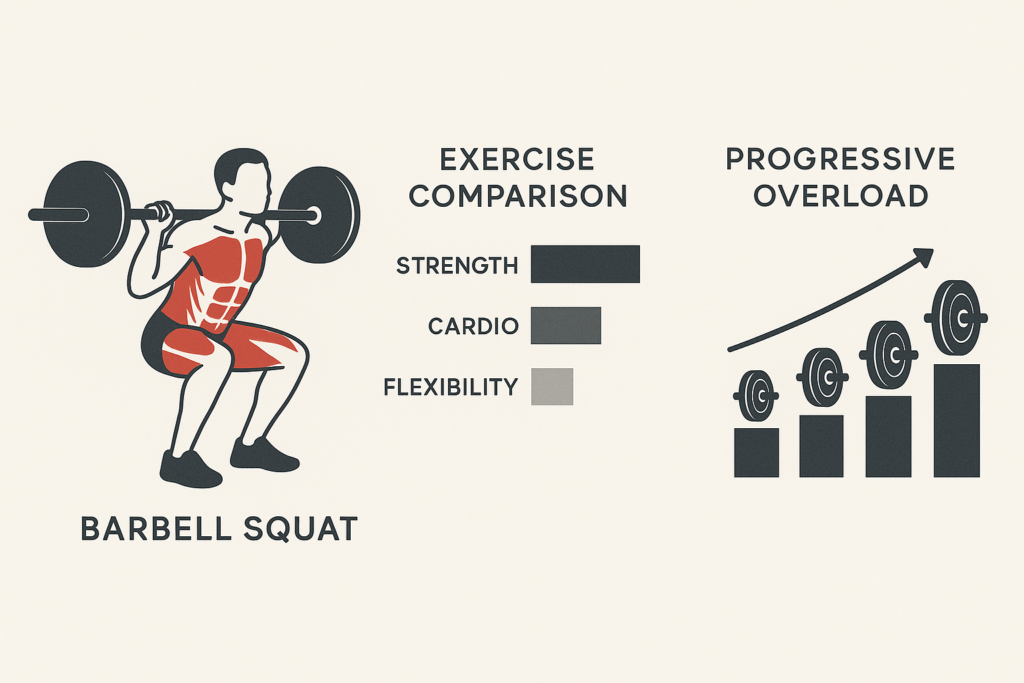
Productive training uses progressive overload, which means increasing the demand
gradually as your body adapts. Progress may come from better form, a fuller range of
motion, another rep, a slower tempo, or a small increase in resistance. It doesn’t
always require heavier weights.
Recovery supports the work you do in the studio. Sleep, protein, hydration, daily
movement, and manageable stress all affect how well muscles repair and how ready
you feel for the next session.
A demanding program paired with poor recovery can stall progress even when effort
is high.
Watch for these common errors:
- Changing exercises so often that you never learn or measure them
- Using momentum instead of controlling the intended movement
- Holding your breath without a clear reason or losing trunk position under load
- Ignoring pain because an exercise is popular or appears in a template
- Skipping recovery while adding extra workouts, classes, or cardio
- Comparing your starting weights with someone elseʼs current level
- A qualified coach can shorten the learning curve by selecting the right variation, adjusting the range, and giving feedback while you move.
That support is especially helpful if you have arthritis, previous injuries, limited
mobility, or anxiety about training in a public gym.
Why Personalized Training Helps New Clients Progress
Generic programs can provide ideas, but they can’t watch your form or account for how you feel on a given day. Personal training adds observation, coaching, and accountability.
A trainer can see whether a joint is shifting, whether the load is changing your technique, or whether another variation would help you train the same pattern with better control.
Body360 Fit uses a private, personalized, and precise model for clients who want focused progress without crowds or wasted time. Each new client starts with a Functional Movement Screen.
From there, the trainer builds a program around current ability, goals, movement patterns, and schedule. Sessions can combine strength work, mobility, corrective exercise, and conditioning as needed rather than forcing every person into the same template.
The private studio gives beginners room to ask questions and learn why each exercise belongs in the plan. That education supports better choices outside the studio during travel, busy work periods, or schedule changes.
For busy professionals near Beverly Grove, this approach keeps training focused. You arrive with a plan, receive direct coaching, and leave knowing what comes next.
Ready to Build Strength with a Clear Starting Point?
Strength training is appropriate for many people because it can be scaled to the person, not the other way around. Beginners, older adults, women, athletes, and people returning after a break can all make progress when training is matched to their needs.
Start with manageable resistance, repeat the basics, protect your form, and allow enough recovery for your body to adapt.
Body360 Fit offers private coaching for people who want a smarter, more personal way to train. Your first step is a complimentary Functional Movement Screen, followed by a plan built around how you move, what you want to accomplish, and how training fits your life.
Book your free assessment to meet a certified trainer and get a clear
recommendation for where to begin.
— Christian Graham
Founder, Body360 Fit

![Full Body Kettlebell Workout [PDF] | Body360 Fit](https://body360fit.com/wp-content/uploads/2021/01/Full-Body-Kettlebell-Workout-PDF.png)