Estimated reading time: 7 minutes
Functional Strength Training For Longevity
Here are four research-backed strength markers that reveal exactly how well your body is aging.
Let me ask you something about functional strength training for longevity.
When was the last time you thought about how your body will feel in ten years? Not how it looks — how it actually feels.
Can you carry groceries up a flight of stairs without your lower back tightening up? Can you get off the floor without grabbing something? Can you stand on one leg with your eyes closed?
These aren’t trick questions. They’re markers.
Research suggests they may matter more than your resting heart rate, your cholesterol panel, or how many miles you log on a treadmill.
The people I train here in Los Angeles — executives, entrepreneurs, professionals pushing hard in demanding careers — come to me because they want to perform. Not just in the gym. At life.
The truth is you’re still an athlete. Your arena just looks different.
Your career depends on your brain firing on all cylinders. And your brain runs on a body.
That body is either supporting your performance — or slowly eroding it.
The good news?
There are a few simple strength markers that reveal a lot about how well you’re aging.
Key Takeaways
- Functional strength training for longevity focuses on maintaining abilities that keep you capable as you age, not just fitness.
- Grip strength is a key predictor of overall health and longevity; training it can significantly impact your aging process.
- Balance training after 40 is crucial, as balance declines with age and impacts fall risk and functional movement.
- Exercises like Turkish getups and loaded carries build functional strength, enhancing real-world capabilities.
- Aim for two to three strength sessions each week, emphasizing compound movements and improving stability.
Dead Hangs: Why Grip Strength Predicts How Long You’ll Live
Grip strength surprises people every time.
Yet research consistently shows it may be one of the strongest predictors of overall health and longevity.
A landmark study published in the National Library of Medicine found that grip strength is a reliable biomarker of muscle function, bone density, cognitive health, and all-cause mortality¹.
Another study found weak grip strength and poor standing balance predicted both cardiovascular and overall mortality².
Translation: the strength in your hands reflects the strength of your entire system.
Many longevity researchers now consider grip strength a vital sign of aging.
How to Train Grip Strength
Grip strength is easy to train.
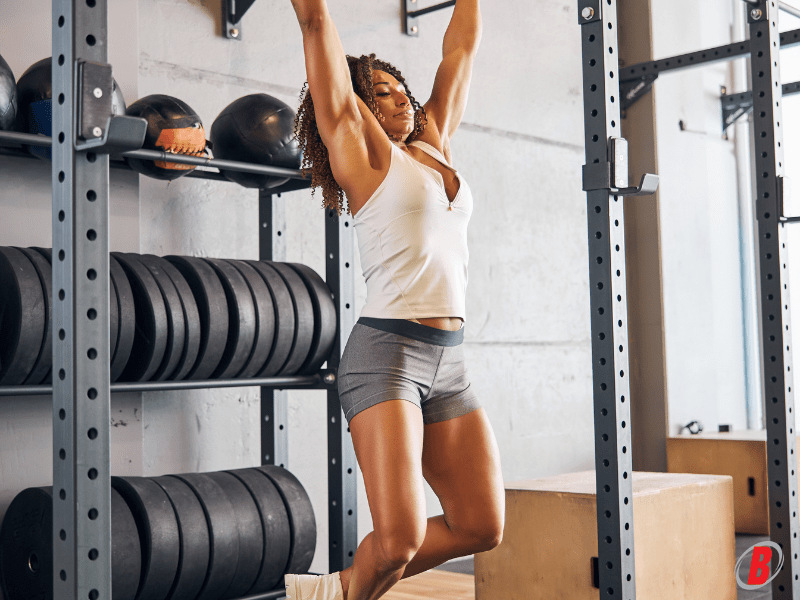
Start with a dead hang.
Grab a pull-up bar and hang for 20–30 seconds.
Gradually build toward 60–90 seconds.
Train this twice per week.
Your grip improves.
Your shoulders decompress.
Your spine benefits from the traction.
Single-Leg RDL: Why Balance Declines After 40 (And How to Fix It)
Balance declines faster than almost any other physical marker as we age.
The National Institutes of Health reports that the ability to balance on one leg decreases significantly after middle age³.
One study found that people unable to balance on one leg for 10 seconds were three times more likely to die within the following 13 years.
Three times.
Which is why balance training over 40 becomes so important.
Balance isn’t just athletic ability.
It’s a survival skill.
How to Train Balance
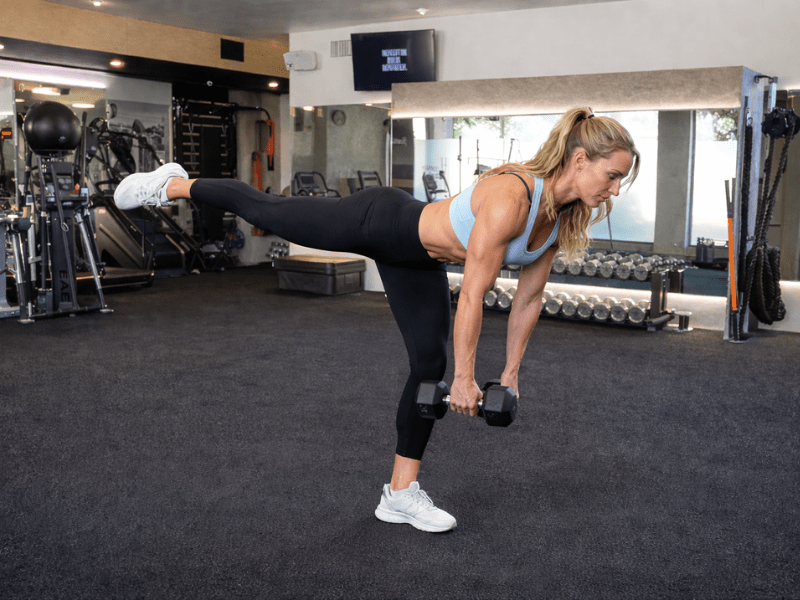
Single-leg strength training is one of the best ways to build balance.
Start with the single-leg Romanian deadlift.
Stand on one foot.
Hinge at the hip.
Keep your spine neutral.
Start without weight.
Then add a light dumbbell or kettlebell.
Your ankle, hip, and core stabilizers immediately engage to keep you upright.
That’s the system we want to train.
Turkish Getups are the One Exercise That Reveals Everything
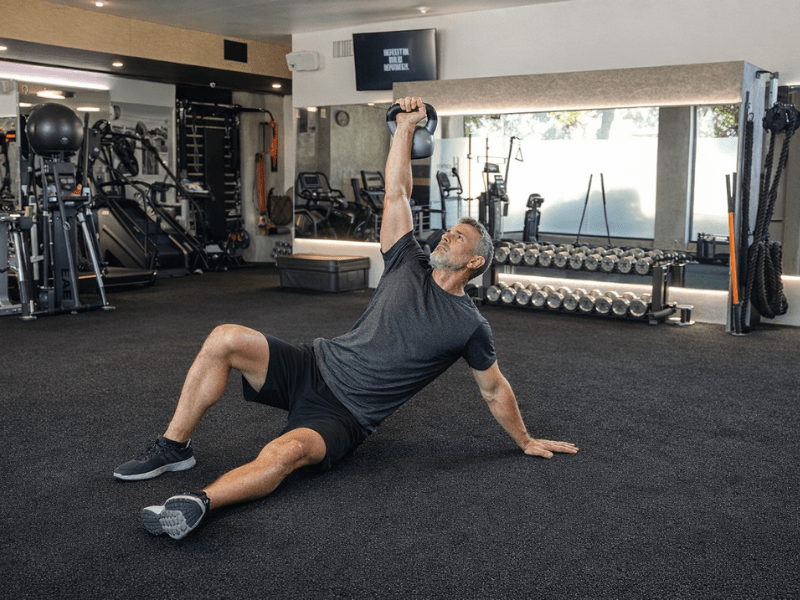
If there were one movement I could prescribe for most adults over 35, it would be the Turkish getup.
The exercise moves you from the floor to standing while stabilizing weight overhead.
That single movement challenges nearly every major system in the body.
Shoulder stability.
Hip mobility.
Core strength.
Coordination.
Few exercises reveal weaknesses faster.
Which is exactly why it’s so valuable.
How to Learn the Movement
Start simple.
Lie on the floor and raise your fist toward the ceiling.
Practice the pattern slowly and deliberately without weight.
Focus on smooth transitions between positions:
- Roll to the elbow
- Post to the hand
- Bridge the hips
- Sweep the leg through
- Stand tall
Once the pattern feels natural, gradually add load.
Start with a very light kettlebell, dumbbell or no weight at all.
The goal isn’t weight.
The goal is control.
Why Loaded Carries Build Real-World Strength
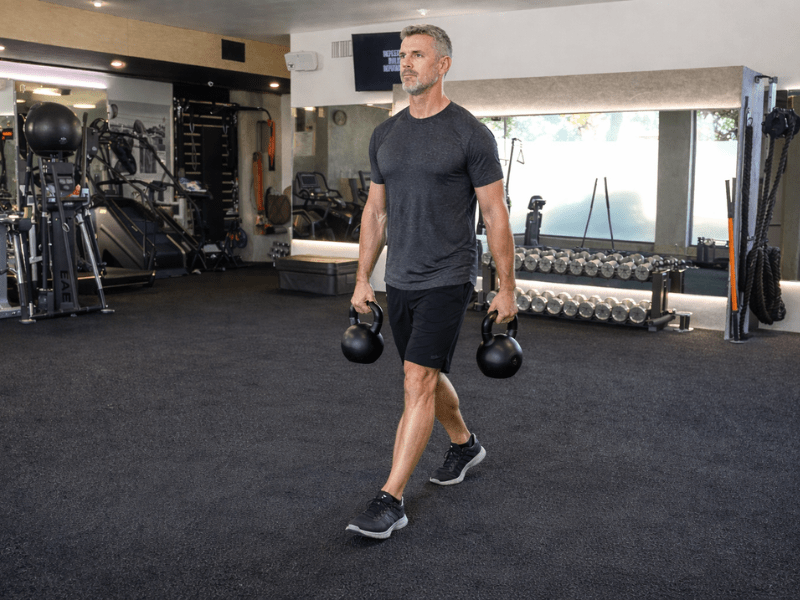
Pick something heavy up.
Then walk.
That’s the exercise.
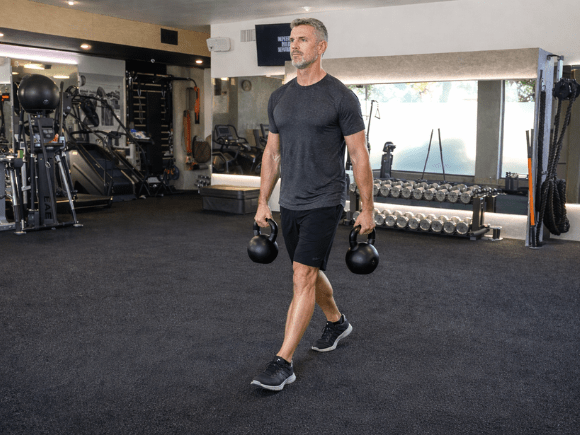
Farmer’s carries train grip strength, core stability, posture, and leg strength simultaneously.
Researchers often use loaded carries as a measure of functional fitness because they closely mirror real-world demands.
Carrying groceries.
Moving boxes.
Holding luggage.
Picking up a child.
This is real-world strength.
How to Train Loaded Carries
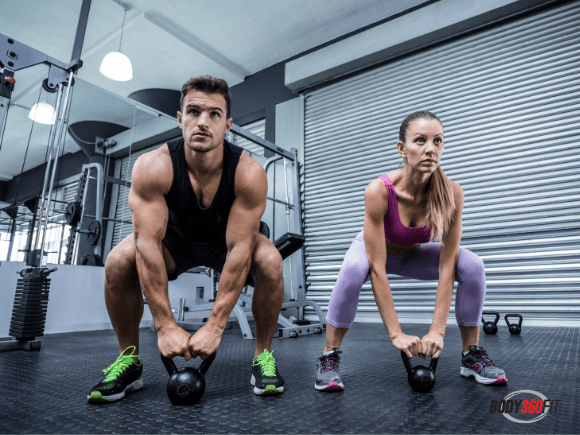
Start with dumbbells or kettlebells.
Carry them 20-40 feet.
Stand tall.
Engage your core. Squeeze what you’re carrying firmly.
Avoid leaning side to side.
Gradually increase the weight as your strength improves.
Strength built this way transfers directly into everyday life.
What Functional Strength Training for Longevity Really Means
Functional strength training for longevity isn’t about chasing bigger numbers in the gym.
It’s about maintaining the abilities that keep your body capable for decades.
Strength that helps you move, lift, carry, stabilize, and recover.
Many people spend years exercising without addressing these abilities.
Cardio machines. Isolation exercises.
Meanwhile, movement quality slowly declines.
Then injuries appear.
Back pain.
Knee pain.
Balance issues.
Functional strength training helps address these problems before they become serious limitations.
The goal isn’t just to stay fit today.
It’s to stay capable for decades.
Where to Start
Pick one movement this week.
Test your grip strength.
Practice a single-leg exercise.
Learn the Turkish getup.
Carry something heavy.
Small improvements in these markers can dramatically change how your body ages.
Start with one movement this week.
Strength compounds — and your future body will thank you.
— Christian Graham
Founder, Body360 Fit
PS. If you’d like help building strength safely and progressively, that’s exactly what we work on with clients at Body360 Fit here in Los Angeles.
You can learn more about our approach or start with a free Functional Movement Screen assessment.
FAQ
Research shows grip strength correlates strongly with overall muscle function, cognitive health, and mortality risk. Many researchers now consider it a “vital sign of aging.”
Balance declines with age due to muscle loss and neurological changes. Training single-leg strength and stability can dramatically reduce fall risk and improve functional movement.
Exercises like dead hangs, Turkish getups, farmer carries, and single-leg strength training all build functional strength that supports long-term health and mobility.
Most adults benefit from two to three strength sessions per week, focusing on compound movements and stability training.
Citations
¹ Grip Strength: An Indispensable Biomarker for Older Adults. National Library of Medicine.
² Kurotani K, et al. Associations of Walking Speed, Grip Strength, and Standing Balance With Mortality. PubMed.
³ National Institutes of Health. Assessing Ways to Gauge Aging Status.

![Full Body Kettlebell Workout [PDF] | Body360 Fit](https://body360fit.com/wp-content/uploads/2021/01/Full-Body-Kettlebell-Workout-PDF.png)